|
_small.jpg) |
-
There are over
350 species of termites in Australia, of which some 20 species can damage
timber homes.
|
|
|
What damage can termites do to your wood house stumps?_small.jpg) |
Termites live in colonies in your wooden house
stumps and will make a nest in one or more of them, one wooden house stump can
house some one hundred thousand or more white ants, all working away to eat out
the timber stump from the inside where you can not see them; leaving
only a thin
wooden outer shell after they are finished eating the timber.
If your timber stumps
DO NOT have ant capping, or what is known
as a 'stump cap' in the trade, or the stump caps are old and showing signs of
rusting as shown here, there could be a small pin hole or a larger hole in the
metal stump cap. Termites will eat their way up the middle of the wood
stump to the top, find this hole and then make their way into the timber bearer
and into the walls of your home all undetected by you until it is far too late!
Thousands of dollars or even tens of thousands
of dollars of damage
are done in
some cases...
|
|
|
_small.jpg) |
Just one rusted ant cap can cause all
these problems... |
|
|
|
|
|
_small.jpg)
|
Note the termite trails
above leading to cover
and into the home?
Not what you
need as it is a costly repair.
|
|
|
|
_small.jpg) |
These photos show just how termites work
undetected |
|
|
This elderly woman was led to
believe that if she treated the termites every six months, this
problem
would be solved and all the termites would be gone, but sadly, that was not
the case.
You can see from the photo above that the white ants went right up the
wooden stump, found
a hole in the ant cap and went into the wooden bearer...Luckily in this case the stump was
removed in time
before the termites got
into the home.
|
|
_small.jpg)
|
Note the termite’s tracks above
the new concrete stump I put in to rid the home of the old termite infested
wood stump and how they made their way up and along the bearer and into
the 'VJ' pine boards in an attempt to gain entry to the house. |
|
|
_small.jpg) |
|
|
|
_small.jpg) |
|
|
|
Back to Top
|
|
|
How to spot a
termites nest
|
|
|
|
_small.jpg) |
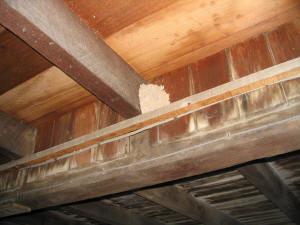
Here are a couple of photos of
a termite nest under a home. |
_small.jpg) |
|
The above photo
(left)
was taken with a flashgun & the one on the right was taken
without any
flash, to demonstrate just how hard it is
to see a termites nest under a dark house...Nests like
this, built in a dark corner, attached to the timber floor joist and
the 'V.J' pine internal wallboards,
clearly
demonstrate how common it is to miss things like this when you are walking
around under
your home.
|
|
|
|
_small.jpg) |
These photographs
show just how the termites attempt to camouflage themselves and track their
way into your home... |
|
|
_small.jpg) |
This is a photograph of a termites
nest, made on top of the wooden house stump. The termites
infiltrated into the stump, working
their way up the middle of it to the top, building a huge nest in readiness to make their way
into the bearer and into the home... |
|
|
|
|
|
|
|
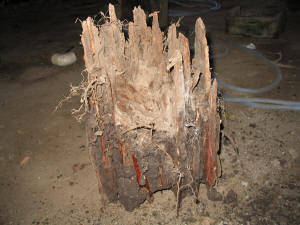
_small.jpg)
This is a wooden house stump that over the years dried out, causing the timber
to split. This made a nice home for termites to live in; you can see the
termite tracks in the split wood...
Due to bad advice from a
so called professional pest control man,
the termites got into half the wooden stumps under this elderly woman’s
home causing a very costly problem for her to fix. This brings a question
into mind; WHY did he not tell this woman that the stumps were in such a
bad state and to have them replaced? The only answer that comes into my
mind, is that when you know that you're guaranteed a call back to inspect for
termites in the wooden house stumps and poison every 6 or 12 months - why
would you tell the person that the wood stumps are rotten and to replace
them in concrete when concrete stumps do not need to be poisoned, thus
reducing the amount of wood stumps needing to be treated, cutting down the
amount that the pest man can charge (would you be honest and take a pay
cut?)
|
|
|
|
|
|
_small.jpg) |
Termites travel underground and get into a wooden house stump at the
bottom.
This photo clearly shows them eating their way into the centre and then up
the stump.
Note how
they ate their way from the outer edges of the wooden stump
into the centre, working their way up the middle...They were
protected from the elements and worked away happily undetected. |
|
|
Termites must keep out of
the elements (sunlight and heat), for white ants must stay
moist to stay alive. Their nest must also be out of the
elements for the nest to survive, although in some cases their nests
are exposed to a degree of sunlight but the mud composition of the
nest insulates them from the heat. Moisture plays a big part of a
termites survival and that is why termites will make a nest in the
bottom of a wood stump or under a concrete slab underneath a home.
Termites
will also make nests in the base of a living or dead tree in your yard
or your neighbours yard or wood fences and will travel underground
looking for fresh timber to eat.
Termites do not like to be
disturbed, so if you neighbour has house restumping done or puts up a new
fence and the termites are disturbed, they will then often move to
another location in search of wood and in most cases - your stumps!
If you have a termite
problem and you replace some old wooden termite infested
house stumps with new concrete stumps and the termites are not
treated before the removal of the old stumps; being disturbed, they
will again relocate to one or more of your remaining wooden house stumps
and start all over again!
|
|
|
 |
Why did termite treatment
not work for this person? In this and many
cases, mainly because the pest control man was called far too late and the
damage was already done. |
|
|
The treatment process could not work,
as the hole in the middle of the wooden house
stumps was far too great and the poisons did not take.
|
|
|
The following photos
will show you why... |
|
|
_small.jpg) |
This is a photo of one of the
old wooden stumps; note the hole that was drilled into the side of the
stump by the pest control man, at what would have been just above
ground level?
This is where the poison was put into the stump,
in an attempt to eradicate all
termite activity, but it did not work. In this case it was a waste of time and good money.
As you can see; the stump was already very much hollowed out and the poison did not soak into the
stump as it was meant to do. All that happened was the poison ran down one
side into the ground and did not stop a single termite. How do I know this?
When we removed the stump and it dropped to the ground; the ground where
if fell was white with termites crawling every where! The damage was done by the
termites at ground level, as the stump is hollow and the poison
could not do what it was meant to do. It did not stop the white ants
from eating out the stump. Note the termite damage at the bottom of
the stump - The termites ate all but a few millimetres of the
stump away, leaving just enough wood there so as to not be noticed.
|
|
|
The photo below shows
the same
stump turned upside down. This gives an inside view of how the poison
was unable to do anymore than run into the ground, as the centre of the
stump had been eaten away and the termites were still happily munching
away
unaffected!
|
|
|
 |
People who own
'Queenslander'
homes on wooden house stumps, know just how costly it is for termite treatment
every six to twelve months. What you are seldom made aware of
however, is how many
of those stumps are hollow in the centre, but every six or twelve
month interval, the pest control man pays a visit to 'treat the stumps' when
what really needs doing is replacing, not treating! |
|
|
Read MORE facts
about treated wooden house stumps HERE
Back to Top
Early detection
Please do not read this the
wrong way; it is a wise idea to contact a pest control person to
inspect your property at least once a year, to inspect and look for
early
warning signs of termite activity.
|
|
_small.jpg) |
If you do not keep an eye out for this problem,
this could happen to your home, if left undetected...
|
|
|
The photos above and
below are of one of the worst houses I have ever been asked to quote
on...The termites attacked this home with such
vengeance for so many years with nothing ever done about them and
now it is far too late to do a thing to fix it. The condition of this
home is that dangerous it should be reported & condemned; There are
NO back steps or a back wall. There is virtually NOTHING left
to support the roof as you
can see; one red trolley props up the refrigerator! The
bathtub has gone
through the floor and it now lays on the dirt underneath the house!
Many
of the wooden stumps have fallen over and the stumps that are
still standing, have sunk way out of level, yet the owner is still
living in the home!
(I would not walk within 5 meters of this house,
let alone go under it or live in it) yet this man will not leave the
home... |
|
|
_small.jpg) |
Do not let this
happen to your home!!! |
|
|
|
|
|
|
The photo below is a termite
nest hidden between trees in the owners back yard. It
demonstrates clearly that termites can hide themselves very well
and blend into the surrounding area, so as to not stand out - making them harder
to see and to find. This nest was stumbled upon by pure chance!
The
mother nest was built in moist, soft ground in the shade of trees, to
prevent direct sunlight prematurely drying out the nest.
|
|
|
|
...More
photos of the same home - You can see termite damage to a structural
timber bearer supporting the rear deck of this home...
(Either the building inspector was blind or
did not care!)
As well as a partial
timber sleeper, which in fact is part of a timber retaining wall, some 2.5
meters in height and 4.5 or so meters long.
Filled
with dirt and builders rubble right up to the structural timber bearer,
this home had no termite barrier in place to stop any termite access to
the timber. In fact, none of the timber sleeper retaining
walls were constructed from F 17 treated timber as required
by building code laws. They were instead, constructed from
non-treated standard timber, which was not picked up in the building
report when the home was purchased three years ago. In fact, there
are several faults that I had found when I was quoting to repair
the problems, which were never found nor stated in the pre-purchase
building inspection report.
...The same house;
Can you see the nest? This was INSIDE of the bedroom wall! The
owners were luckily alerted to it when they heard an odd sound that they
describe as "munching"...Subsequent investigation revealed this little
surprise! The pest control people were called out and the termites
eradicated, but not before they had done extensive damage, necessitating
expensive replacement of the house frame in this area.
Still at the same
house; The owners have recently found these little "mini volcano
pipes" BETWEEN their pavers under their back veranda - THIS is a classic
termite 'building project'; the material they use to start building their
nest (Which without VERY PROMPT attention would become a HUGE termite
mound!), is actually the remnants they have EATEN from the wooden
retaining wall, two photos up! |
|

 |
|
I have to say this;
It takes the
same amount of time and effort to do a good job using the
correct materials and treated timbers, as it does to do a
BAD job.
It takes years to
build up a good name and reputation for yourself and only five minutes
to create a bade name and reputation for your-self and destroy your
reputation for life - So why would a contractor or person bother to
short cut on quality, for the sake of price and cheap materials?
But then again, all
the extensions and renovations done here to this home, was by an
OWNER-BUILDER. |
|
|

|
Here you
see active termites, happily eating out the non-treated timber sleeper retaining
wall. If this timber had been treated and termite-proofed from
day one
by the 'OWNER-BUILDER' - NONE of these problems would've
occurred and the new owners would not have to pay to fix the
problems that the previous owner had left them with. If the
'building inspector' wasn't blind and did a proper inspection in the
first place and noted the problems in the report, that termites
were
active in the timber sleeper retaining walls, (as termites do not
just turn up over night) an informed decision could have been made
as to whether or not to buy the home, rather than get stuck with a costly
problem which is now a priority to fix and that now requires the
assistance of a structural engineer beforehand. |
|
|
Back to Top
What you should & should not do
What
should you do?
-
As
wooden stumps get older, they are prone to start splitting and cracking.
This is caused by the drying out of the timber, above ground level.
As the cracks start to appear, treat as soon as possible with a
'gap filler' compound, as this will stop any moisture getting into
the stump and causing dry rot from starting. It will also stop any
'unwanted pests' from making your wooden stump their home.
-
Check
both your front and back steps under the bottom
tread for signs of termite tracks or mounds. If your bottom step
tread is very close to the ground, be very vigilant - for the
closer to the ground that the step treads are, the easier it is for the
termites to get into.
What should you
NOT do?
-
Do not build gardens against your wooden
stumps, or the wood palings between your stumps, as this will only
attract termites faster, as does the pine bark used to cover the gardens
to retain moisture.
-
Remove any old tree stumps in your yard
and poison the area before filling the hole made by removing the
old tree stump. Tree grinding is an option, but will only
remove the bulk of the old tree stump and not the roots, which the
termite will also remain in and use as food and as a conduit to travel
underground in your yard.
Back to Top
Termite control
|
|
|
_small.JPG) |
I have drawn this diagram to show you how termites attack your wooden house stumps and
find their way into the walls of your home. |
|
|
|
|
|
_small.JPG) |
This
diagram shows what you
can do to
control and limit
termite access and their entry into your home. |
|
|
Back to Top
|
|
|
|
|
|
|
|