|
|
What causes timber stumps to sink?
The TRUTH about wooden stump treatment!
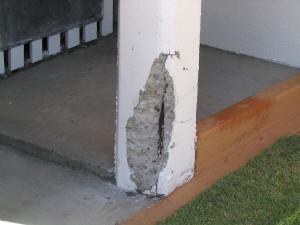
What causes concrete stumps to crack or 'blow out'?
 |
 |
|
|
 |
 |
 |
 |
|
|
What causes timber
stumps to sink?
Most people think that
when windows or doors will not close properly and the house seems
to be on a 'bit of a tilt', or the floors seem to be uneven to walk on,
that it is the house 'settling'...Phone calls to house re-stumpers are
made to obtain quotes to pack and re-level the wooden house stumps to
correct the problem and make the home level again.
This is nothing
but a waste of time and your money
when timber stumps are
involved! I know only too well, that there are many re-stumping
contractors who will come out and charge you good money to pack wood
stumps back to level, knowing full well that the stump/s
will sink again, within a short period of time and they
will be called out to do the packing again for you - not
telling you what the real problem causing the timber
house stumps to sink is...
...So I will tell
you now;
If timber house stumps sink, there are causes and reasons as to why
this has happened.
The most common cause of a wooden house stump to sink
is;
Termite
damage.
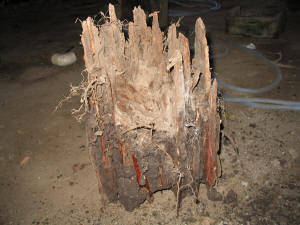
At the bottom of this
stump, which was once a round solid wooden stump, is now little
more than a hollow shell where the termites have eaten a very large
deep hole into the bottom. This caused the stump to
become unstable, allowing the weight of the home over that stump, to
push it down into the dirt below...
This
hole made by the
termites allowed the dirt to be PUSHED UP, inside the
middle of the stump - See the bottom of the stump with the mud pushed
inside of it?
|
_small.jpg) |
_small.jpg) |
|
After the stump was hosed off
and cleaned up, we then used a chainsaw to cut it, showing you the full extent of
damage done by the termites. This is WHY it is practically impossible to pack
or repack a wooden stump that has sunk and why it is silly to pay out good
money to have a stump packed when it really should be replaced in the
first place. |
|
Packing wood house
stumps may be a relatively cheap alternative to the replacement of a stump, but
knowing what you do now; would you still pack a lose or sunken stump?
OR
would you replace it saving money? For once replaced,
it will never
have to be done again, and you will not have to be on the phone to a
house re-stumper every couple of months to repack the problem.
If a house re-stumper tells
you that packing a wooden house stump is "ok to do" and re-levelling it
will fix the problem, and that "you will have no more trouble with it";
DO NOT believe him!
How would he know in the first place, unless he has
x-ray vision and can see into the ground, the condition of the bottom
of a wooden house stump? HOW is it possible to pack and level something
that is hollow? (As the photo above shows)
Ask yourself;
if your
boat had a hole in it, would it still float?
If
it had a make shift 'patch up' job done to it - NO; it will sink, just
like a wooden house stump will do; It will sink again
and faster in rainy weather, as water will sink into the ground
causing the dirt under the stump to turn to very wet mud,
thus combined with the weight of the house over that stump, the mud
will be pushed upwards INTO the hole made by termites!
Question : Is it
legal
to pack wood or concrete house stumps?
Answer :
Yes, it is,
but,
by law only up to and not
exceeding 50mm (2 inches).
IT IS
ILLEGAL
to pack over 50mm (by building code law) and all
offending house stumps; concrete, wood or steel columns lower
than 55mm must not be packed and must be replaced.
The second most common
cause of a wooden house stump to sink is;
'Dry rot'; where the lower
part of the stump rots away, leaving two sections of stump in the
ground and a big gap between both parts of the top and bottom
half, causing the top half to sink away from the home, leaving a gap
and the stump can be moved with ease.
Another
common cause of dry rot in a wooden
house stump, is when the stump is replaced and concrete is used to
fill the stump hole first, before the new wooden stump is installed.
When concrete is laid, it will suck in and hold moisture.
The new wooden stump is dry, and we all know that timber will also
suck in and retain moisture; therefore speeding up the process of
rotting the new stump.
Note the tree roots
in this scenario? A
garden was built up against this stump. Watering the garden on a
very regular
basis, played a big part in the rotting of this stump...
|
_small.jpg) |
|
The third most common
causes of a wood or concrete stump to sink
is;
The soil
itself;
Reactive clay soils,
as well as houses built on old flood plains.
Brisbane has
quite a few areas like this, such as; Rocklea, Acacia Ridge, Stones
Corner, Anstead & Pullenvale - just to name a few...
In the early days from
the 1920’s and now days as Brisbane grows, more land is needed to be
developed for housing and much dirt is dumped and used as land fill to
fill up old water holes, creeks and gullies, as well as flood plains and
this was done all over Brisbane in many suburbs, thus causing some homes in
some areas after a time, to start moving. This causes house stumps to sink
and it's due to this
sinkage in the soil, that some areas in Brisbane have what is called 'black soil';
very much like the soil in Ipswich. This soil is very reactive and a lot of
movement does occur when it rains, as the soil swells. When the weather is
dry, the soil will sink and small to large cracks will appear in the ground.
Areas such as this, should be avoided if you're looking to buy a home.
To
find these areas, refer to old maps of Brisbane which the B.C.C. town planning
should have on hand that you can use as reference.
Back to Top
What causes concrete
stumps to crack or 'blow-out'?
There are many reasons as
to why a concrete stump cracks - the most common causes are as follows;
Before we had 'recycling'
(as we do now), all concrete was dumped. Nowadays, it is usually
sent to a recycling plant and crushed, where it is sold back to the
trades’ people as 'concrete blend'.
Gravel used to be dredged
from the Brisbane River, but this activity was finally ceased, over ten
years ago. Gravel sourced from this saltwater river, was sold at the
time as 'washed' gravel. It was however 'washed' in the salt
water from the River, then placed in wooden hoppers to be sold at a
South Brisbane plant which has now also been demolished and a new plant
constructed.
Most people know, that to
make concrete stumps, you need sand, gavel, cement powder, steel
reinforcing rods & water. Back in my dads day, all this was done by
hand - the mixing of the concrete, the cutting of the steel rods with hack
saws, and the stumps were made in square timber boxes...The problem
was, that the gravel used then as explained, came out of salty water
from the Brisbane River and when you added fresh water into the mix
- this activated the salt! This in turn made the steel
reinforcing rods (which were not galvanised back then and are still not
galvanised today
& should be!),
start to form rust (oxidisation).
Also
back in my fathers day, it was common practice if the steel reinforcing
rods were cut too long, they were hammered into the ground below the top
of the timber boxing, thus allowing rust to form - as back then, all
concrete stumps were made on-site, in free standing timber boxes over the
stump hole. Today, the concrete stumps are prefabricated in steel
form work, laying flat.
Other causes
for concrete stump cracking;
|
_small.JPG) |
_small.JPG) |
|
These photographs
shows how
the steel rod was pushed below the base of the concrete stump into the
ground, where moisture was able to
attack the steel rod, allowing the rusting process to begin... |
_small.JPG) |
 |
|
You can see
here,
how the rust travels up the steel rod inside the concrete, making the steel rod
double in size where it will cause
cracking of the concrete stump.
When this occurs,
the steel rods are then vulnerable to moisture, expediating the rusting
process...
Large pieces of
the concrete stump then crack and fall away, exposing the steel rods and allowing the elements to
take hold, wreaking the stump and cutting short it's effective life span.
|
_small.JPG) |
|
Poor
mixing will cause cracks too, as it all was done by hand back then, unlike
today where it is all measured out, so there is no guesswork involved...
Damp
soils will also cause old pre-war concrete house stumps to crack.
Given that concrete retains moisture, this will keep the steel reinforcing
rods damp all the time. The resulting rust eventually causes the
rods to grow to double their original size, which is what makes the
concrete crack, or 'blow out'.
As mentioned, It was common practice
in 'the early days' to make concrete house stumps on-site. The hole
was dug for the stump, the form work (boxing) was put in place and
suspended about 300mm below the ground into the hole. Four or more
steel reinforcing rods were cut by hand using a hacksaw. Concrete
was mixed (again by hand) and placed into the stump hole and drawn up to
the bottom of the wood form work. The steel rods were then placed
into the stump box. If the steel rods were too long - instead of
taking them out and re-cutting them, to save time they were hammered
into the ground, well below the bottom of the base of the stump, thus over
the years causing the moisture in the ground to speed up the rusting of
the steel rods.
I have personally over
time, removed many cracked concrete house stumps and deduced that had the
steel rods been placed in the concrete correctly, the stump would
have lasted many more years...
Back to Top
|
|